Right now, while you're reading this, your competitors are stealing customers from under your nose. They're not necessarily better at what they do: they're just better at being found when it matters most. Local search SEO isn't rocket science, but it's littered with pitfalls that'll torpedo your business growth faster than you can say "Google Maps ranking."
Here's the brutal truth: most businesses are sabotaging their own local search visibility through completely preventable mistakes. If you're wondering why your phone isn't ringing despite having a decent website, chances are you're guilty of at least three of these local SEO sins.
Let's fix that before Google notices: and before your competitors do.
Mistake #1: Treating Your Google Business Profile Like a Set-and-Forget Afterthought
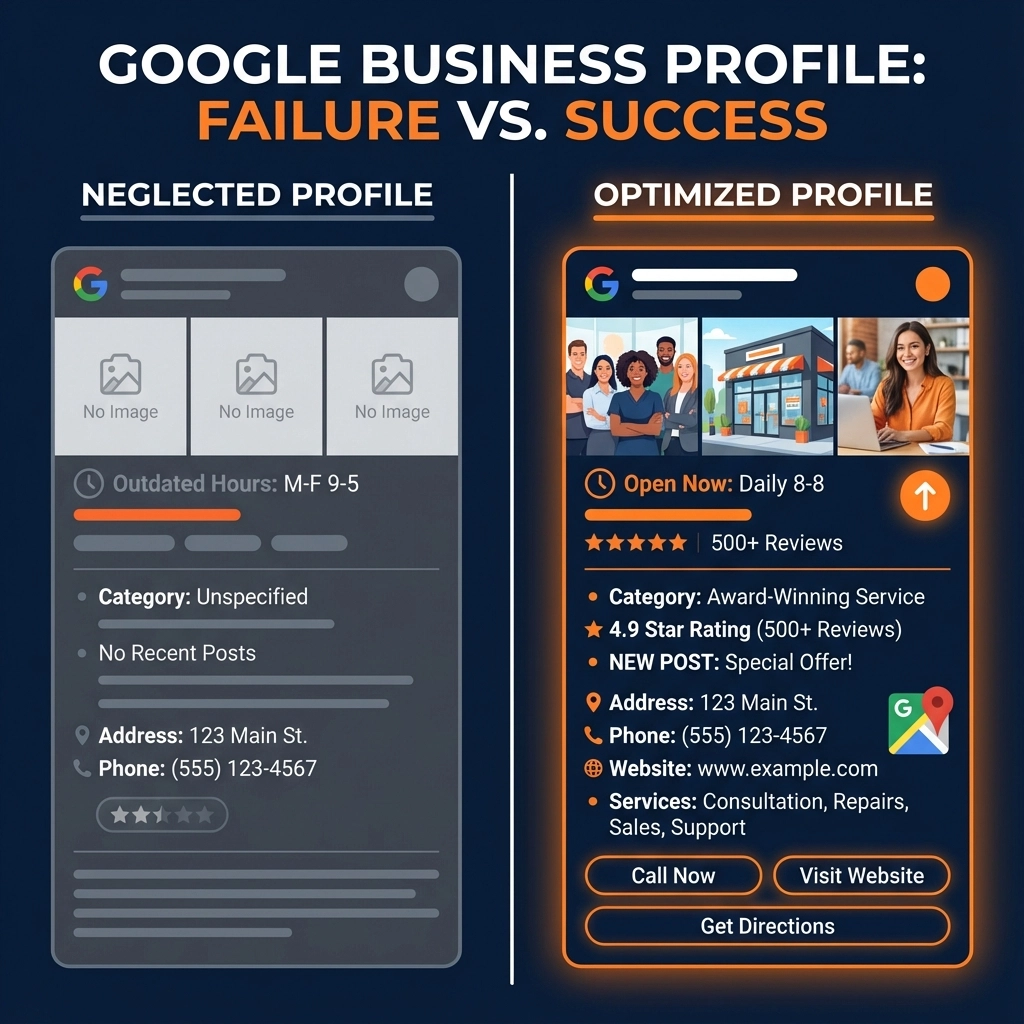
Your Google Business Profile is digital real estate gold, yet most business owners set it up once and abandon it like yesterday's newspaper. This is like having a shopfront on the high street but never turning the lights on or updating the window display.
The damage: Incomplete profiles signal to Google that you're either closed, unprofessional, or simply don't care about local customers. Meanwhile, your competitors with optimised profiles are hoovering up the customers you should be getting.
The fix: Transform your profile into a living, breathing showcase of your business. Upload high-quality photos that actually show what you do: not stock images that scream "generic business template." Keep your opening hours religiously updated, especially during holidays. Add posts regularly showcasing recent work, special offers, or industry insights. Think of it as your free marketing platform that Google actively promotes.
Mistake #2: Playing Fast and Loose with Your NAP Details
NAP consistency: Name, Address, Phone number: isn't just bureaucratic box-ticking. It's how Google verifies you're a legitimate local business rather than some fly-by-night operation. Yet businesses routinely list themselves as "John's Plumbing" on one directory, "John Smith Plumbing Services Ltd" on another, and "JS Plumbing" on a third.
The damage: Inconsistent NAP details confuse Google's algorithms and dilute your local search authority. Search engines can't confidently connect all your online mentions, effectively splitting your digital identity across multiple weak profiles instead of building one strong presence.
The fix: Standardise everything. Choose one version of your business name and stick to it everywhere: Google Business Profile, website header, all citation sites, social media profiles, the lot. Use the same phone number format consistently. If you move premises or change numbers, update every single listing systematically. This isn't glamorous work, but it's the foundation everything else is built on.
Mistake #3: Throwing Darts at Generic Keywords in the Dark
Targeting "plumbing services" when you're a local plumber is like trying to shout over the crowd at Wembley Stadium. You're competing against every plumber in the country, plus the big directory sites with million-pound SEO budgets.
The damage: Generic keywords mean you're fighting battles you can't win while ignoring the customers actively searching for businesses exactly like yours in your area. Local searchers use location-specific terms: they're typing "emergency plumber Nottingham" or "boiler repair near me," not just "plumbing."
The fix: Embrace the power of location-based long-tail keywords. Target "plumber in [your town]," "emergency plumber [your area]," and "[your service] near [local landmarks]." Create location-specific pages for each area you serve. Research what your actual customers are typing: use Google's autocomplete suggestions and check what terms bring people to your competitors' sites.

Mistake #4: Ignoring the Mobile Revolution Like It's Still 2010
Over 60% of local searches happen on mobile devices, yet some businesses still have websites that look like they were designed for dial-up internet. If your site takes more than three seconds to load on mobile or requires users to pinch and zoom to read basic information, you're hemorrhaging potential customers.
The damage: Mobile users are impatient and have options. A slow, clunky mobile experience sends them straight to your competitors who've bothered to join the smartphone era. Google also prioritises mobile-friendly sites in search results, so poor mobile performance kills your rankings too.
The fix: Test your website on multiple devices and internet speeds. Ensure pages load fast, text is readable without zooming, and contact information is immediately accessible. Make your phone number clickable so mobile users can call directly from search results. Simplify navigation: mobile users want quick answers, not elaborate digital journeys.
Mistake #5: Choosing Business Categories Like You're Playing Pin the Tail on the Donkey
Google Business Profile lets you select one primary category and up to nine additional ones. Some businesses pick categories that sound vaguely relevant, while others stick to just one when they could legitimately claim several. Both approaches are leaving money on the table.
The damage: Wrong categories mean you won't appear in relevant local searches. If you're a florist who also does wedding planning but only select "florist," you're invisible to brides searching for "wedding planners near me." Conversely, if you pick categories that don't accurately reflect your services, Google may penalise your listings for being misleading.
The fix: Research which categories your successful local competitors use, particularly those ranking in the coveted Local Map Pack. Select your most accurate primary category, then add relevant secondary categories that genuinely reflect your services. Regularly review and adjust categories as your business evolves or as Google adds new options.

Mistake #6: Treating Customer Reviews Like Nuclear Waste
Many business owners break into cold sweats at the mention of online reviews. They either ignore them completely, hoping they'll disappear, or respond defensively to negative feedback like they're in a Twitter spat with a keyboard warrior.
The damage: Unmanaged reviews signal to both Google and potential customers that you don't care about customer experience. Negative reviews left unaddressed fester and influence buying decisions. Meanwhile, businesses that actively manage reviews build trust and improve their local search rankings: Google loves businesses that demonstrate ongoing customer engagement.
The fix: Respond to every review, positive and negative, within 48 hours. Thank happy customers and address concerns in negative reviews professionally and constructively. Use negative feedback as opportunities to demonstrate excellent customer service publicly. Encourage satisfied customers to leave reviews by making the process simple: send follow-up emails with direct links to your Google Business Profile review section.
Mistake #7: Creating a Frankenstein's Monster of Duplicate Listings
Business information scattered across multiple duplicate listings is like having your name on several different CVs with conflicting employment histories. It confuses everyone and helps no one, especially not your local search rankings.
The damage: Duplicate listings split your review scores, confuse customers trying to contact you, and dilute your local search authority. Google can't determine which listing is authoritative, so none of them perform particularly well. You're essentially competing against yourself while making it harder for customers to find the real you.
The fix: Conduct a thorough audit of your online presence. Search for your business name, phone number, and address variations across Google, Bing, Facebook, Yelp, and major directory sites. Claim and consolidate duplicate listings where possible, or contact directory sites to merge or remove incorrect duplicates. Maintain one authoritative version of your business information and use it consistently everywhere.
The Bottom Line: Local Search SEO Is Your Competitive Advantage
These mistakes aren't just minor inconveniences: they're business killers in disguise. While your competitors stumble through these same pitfalls, fixing them systematically gives you a massive advantage in local search results.
The businesses dominating local search aren't necessarily the biggest or best-established. They're the ones that understand local search SEO isn't about gaming the system: it's about making it ridiculously easy for Google to understand, trust, and recommend your business to local customers.
Start with the mistake that's likely costing you the most customers right now. For most businesses, that's the neglected Google Business Profile. Clean it up, optimize it properly, and you'll likely see improvements within weeks rather than months.
Your local competitors are counting on you to keep making these mistakes. Don't give them the satisfaction.
Categories: SEO Tips, Strategy
Tags: Local SEO, Google Maps, Citation Building, Business Growth, SEO Review, Featured